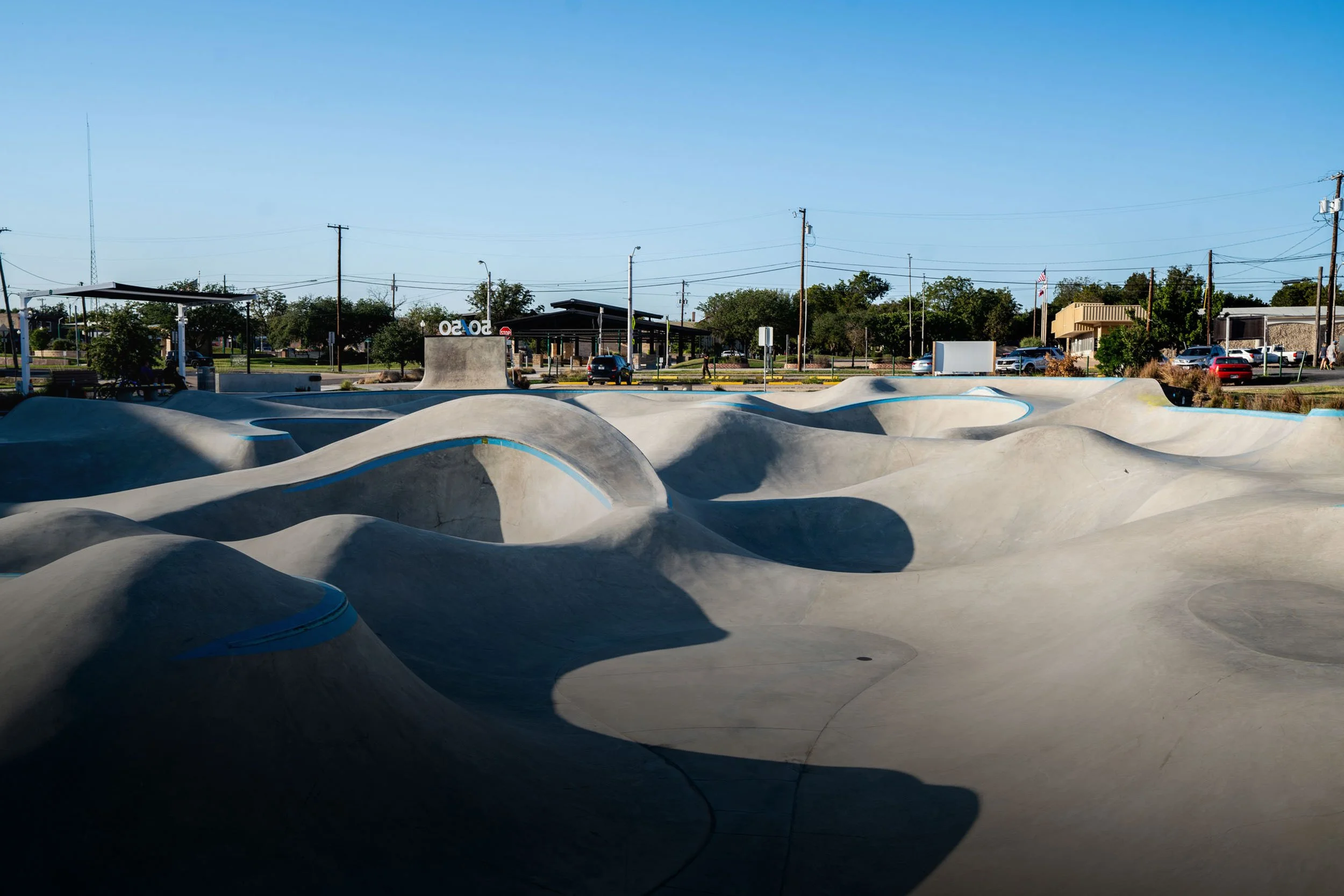
The world we live in today is full of many challenges. We ask a lot of our community leaders, and they are forced into difficult decisions every day. Lets explore the opportunity to combine several unique challenges and deliver solutions that work for everyone.
We know that skateboarding is popular, and that skateparks are generally the most used areas of entire park systems. There are many examples of successful skateparks to learn from (and many more that fall short). The need for more quality skate terrain is well established.
We also hear every day about budget shortfalls across the board, and there is no relief on the immediate horizon. The standard cost for a 10,000 square foot skatepark often lies in the $350,000 range – which is simply unattainable for most communities currently.
Skateboarders learn the value of providing skate opportunities for themselves early on, often starting with driveway ramps all the way up to full blown concrete projects. This is where we combine the issues of a lack of suitable skate terrain, no available funding, and underutilized urban spaces to create facilities that everyone benefits from. There have been countless DIY (Do It Yourself) skatepark projects over the years, some more successful than others. Lets take a brief look at a few of them to see how we can apply their experiences towards a DIY skatepark in your town:
The Burnside Project began in 1990 under a bridge in Portland, Oregon. The rainy climate, lack of skate terrain available, and a motivated group of skateboarders led to the development of the first renegade DIY skatepark.
Like many bridges, the embankments underneath the Burnside bridge were neglected, and allowed to fall into disarray. The area was used for illegal dumping, illicit drug deals, and a transient camp. The skaters realized an opportunity to develop their skatepark. After massive amounts of clean up, concrete was poured at the base of the embankment, making it more conducive as skate terrain. Other features were constructed to compliment what had been built.
The skatepark continues to evolve, with some elements being modified or updated. However, to this day no public funds have ever went into the facility. A majority of the materials were literally donated one bag of concrete at a time. The parks department doesn’t include it as a sanctioned city park, but it does provide a trash dumpster and portable restroom.
Downtown Philadelphia is home to Love Park, one of the most beloved environments for street skating we have ever known. Skating in Love Park was increasingly disallowed, and 1994 saw a 16,000 square foot skatepark built intended as a replacement in South Philly. While this represented the best of intentions, the elements provided proved to be inadequate almost immediately, and the skaters began work on improving the skatepark themselves.
Inspired by the precedent set by Burnside, elements were constructed to compliment each previous development. Other than the initial offering of the failed skatepark elements, $25,000 is the extent of the public funding that has went into the materials comprising the skatepark.
In 2005, FDR hosted the Gravity Games and was also featured in the video game Tony Hawk’s Proving Ground. The park features endless concrete speed lines, a mini ramp and a vert ramp. The park you see today was built with private donations and donated labor, and is much larger than the initial 16,000 sq ft. park provided by the city.
In 2004, Seattle had two skateparks, both of which were scheduled to be replaced in new locations. The frustration caused by having two skateparks demolished drove some skaters under the HWY 99 viaduct south of downtown. Prior to its life as a thriving skatepark, this spot was used primarily for transients living in automobiles, much to the chagrin of the local businesses.
As each feature was implemented, the project became more popular not only with the skaters, but the community as a whole. In a rainy climate such as Seattle’s, the bridge provides welcome shelter. The short days of wintertime have inspired lighting to be installed. It continues to grow, with grassroots fundraisers covering all of the costs. It is estimated somewhere around $40,000 has went into this project, with 100% coming from the skaters themselves.
Washington Street Vigilante Tranny
San Diego is a longtime hotbed of street skating, but over time the anti-skating ordinances continue to get stiffer, leaving some looking for alternatives. The construction of modest obstacles began under a bridge in 1999. Within a year, the authorities discovered the project, and shut it down. A non-profit was formed, land use permits, encroachment and removal permits, and construction insurance were obtained.
An engineering permit (at a cost of $2400) allowed construction to continue. The process of bringing the documentation up to the standards required by the City of San Diego took until 2001, after which the park was completed.
Kings Highway Vigilante Tranny
The entire midwest is largely devoid of quality skateparks: most of them are composed of modular playground equipment. The skaters in this part of the country tend to feel that the only way to acquire adequate skate terrain is to take matters into their own hands.
Underneath the Kings Highway viaduct in St Louis, MO is a vibrant DIY skatespot where only garbage once collected. When the director of the St Louis street department found out about the renegade concrete, he brought his sons down to ride the park. This project continues a model of fundraiser, concrete pour, fundraiser, concrete pour.
Glacier, WA is a secluded mountain town, where there is a real need for projects like the Coal Pad. For the better part of 6 years, the local skaters involved constructed elements at a cautious pace. The spot was literally a coal pad, and has since been used exclusively as an illicit dump. All of the materials used have been recycled from what was found on site, which serves to clean up the area as well as limit costs.
An entrepreneur purchased the land at auction (without knowledge of the DIY project), and has worked with the skaters on donating the skatepark to the Coal Pad non-profit so the park can live on.
Portland, OR is in the process of establishing a system of 19 skateparks. After completing five popular projects in this series, the allocated funding has been exhausted. In an underutilized space under a pedestrian bridge some neighborhood skaters added some concrete to the backside of a highway divider. Fortunate enough to have tremendous community support, this project has continued to grow. Somewhere in the neighborhood of $4,000 has went into this modest skatespot – a valuable addition to a skatepark system.
Bennett is a small town east of Denver, which had a skatepark that had became decrepit over time. Members of the Colorado Coalition for Public Skateparks started on this project in 2006. This project differs from most DIY skatepark projects: it is “permission DIY” – rather than renegade. There are many parallels to the barn building parties of the frontier days, where the entire community contributes a structure for the good of all.
Grassroots fund raising paid almost entirely for the backyard style bowl, as well as replacement for some of the streetscape with better elements. An online fundraiser was also employed, resulting in skaters from CA, OR, WA, amongst other places, contributing significant funding for this project.
In 2002, skaters in San Pedro, CA started building under the 110 freeway at Channel Street. This was a result of getting no where working with the city in trying to get a legit park. Like most DIY projects it started small, so it wouldnt be noticed by Caltrans. As the project grew in popularity, it became accepted by the general public.
In 2004, the San Pedro Skatepark Association was formed and the park became official. Since then the locals have added on to the park tremendously. All of the work was completed by volunteers and donations for materials were provided by skate companies and local contracting companies.
In 1987, the City of Little Rock, Ark built a concrete bowl in Kanis Park. Although this old bowl does not have the smooth tranny and concrete quality that parks have today. The locals took ownership and this bowl has been a part of the Little Rock skate scene since the eighties.
In 2006, the locals took advantage of an underutilized concrete slab down the hill from the bowl. The skaters held fundraisers and collected materials such as rebar and coping. The park has become a mecca for skaters around the Southeast. Every year the locals hold the Kanis Bowl Bash to raise funds for more concrete. The slab at Kanis Park shows how an underutilized slab can be converted into a popular skatepark.


Some friends and I are thinking about starting a small skate spot, with just a rail and quarter for start, if it ever looks as amazing as any of these we will be really stoked
i like what has been done to other parks on the pics.we have a all metal skate park on a concrete pad .. its fall apart and not being taken care of . i just started to get tired of it so me and my fellow skaters are going to the city and try to get them to help us out. the only problem we have with that right now is the city is really disorganized and hasnt managed there money well latley. we just have been wanting to get together with some people that could maybe help out and get are skaters back.. we used to have alot of people that came to the skatepark and it has thrived in are little town befor .. resently it has been like that, people have left and are number have droped bad and we would like to get that spirt of skateing and freedom and joy that comes out of this back . if you know anyone that maybe willing to help please contact me at my email address(sk8pro12@aol.com)
oh yeah and i forgot to metion that we will be willing to donate are own time too and help out anyway that we can
I am amazed how the different skateparks look like. But for me, it would be great if there are no vandalism. The skate park would look clean and decent.
hay all, i am the father of a teenage skate head with no place to skate i guess i am looking for a little advice as how to get ball rolling on a outdoor shotcrete type skatepark for my son and all the skaters in the local to use(i am finding out that there is quite a few). the city were we live does not allow skateboarding on public streets ect… and nearest parks are nearly 20 mi. away so he could not walk to . Ideas,advice would be appreciated. thanks all.
Carl,
We would be happy to help just shoot us an email…
skateparkinfo@gmail.com